
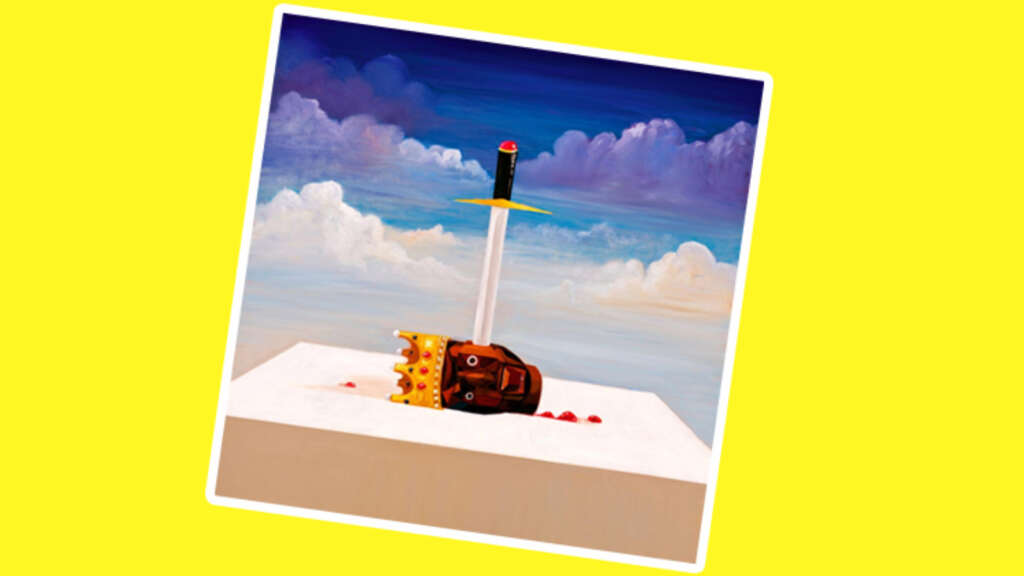
Few producers in hip-hop have reinvented themselves as many times as Kanye West. From the soulful chipmunk samples of The College Dropout, to the orchestral bombast of Late Registration, the electronic experimentation of 808s & Heartbreak, and eventually the maximalist masterpiece that became My Beautiful Dark Twisted Fantasy (MBDTF), Kanye has consistently refused to remain creatively stagnant.
Released in November 2010, My Beautiful Dark Twisted Fantasy arrived during one of the lowest moments of Kanye’s public life. Following the infamous interruption at the MTV Video Music Awards in 2009, public opinion had turned sharply against him. Rather than respond with interviews or apologies alone, Kanye retreated to Hawaii—specifically Avex Recording Studio in Honolulu—where he assembled what many describe as hip-hop’s equivalent of an all-star team.
Artists, producers, musicians, engineers, and writers rotated through marathon recording sessions, often working nearly around the clock. Kanye’s vision wasn’t simply to make another rap album; it was to create a modern masterpiece where every second mattered.
And that philosophy is exactly what separates My Beautiful Dark Twisted Fantasy from almost every other rap album ever made.
Production as Architecture
Listening to MBDTF is less like hearing beats and more like walking through a carefully designed cathedral.
Each song evolves continuously. Instruments appear, disappear, and re-emerge with new textures. Choirs swell unexpectedly. Strings enter without warning. Percussion changes halfway through songs. Background vocals often function as instruments rather than supporting harmonies.
Instead of loop-based hip-hop production, Kanye approached each track almost like a film score.
This cinematic philosophy defines the album.
Unlike traditional rap records built around repetitive four-bar loops, nearly every record here contains multiple movements. Songs expand rather than repeat.
The production breathes.
“Dark Fantasy” – The Opening Statement
The album begins with a spoken-word introduction before exploding into thunderous drums, layered synthesizers, and triumphant vocal arrangements.
The production immediately establishes several themes:
- grand orchestration
- heavy vocal layering
- dramatic dynamic shifts
- enormous stereo width
- dense low-end mixed with pristine clarity
Rather than easing listeners into the album, Kanye overwhelms them intentionally.
Everything sounds larger than life.
Sampling Without Depending on Samples
One misconception surrounding Kanye’s career is that he is “just a sample producer.”
By 2010, Kanye had evolved far beyond chopping soul records.
While MBDTF certainly contains numerous samples, they’re rarely presented in obvious ways.
Instead, samples become ingredients.
Many are pitch-shifted, replayed by musicians, layered beneath orchestras, chopped into rhythmic textures, or blended so seamlessly with live instrumentation that casual listeners often don’t recognize them.
This approach reflects the influence of classic producers like Quincy Jones and film composers more than traditional hip-hop beatmakers.
The sample is no longer the song.
It becomes one color on an enormous canvas.
“Power” – Organized Chaos
“Power” is perhaps the clearest demonstration of Kanye’s philosophy.
The production feels almost impossible.
Marching drums.
African-inspired vocal chants.
Industrial synthesizers.
Progressive rock textures.
Choirs.
Layered percussion.
Distorted bass.
Minimal verses.
Every component competes for attention.
Yet somehow nothing sounds cluttered.
This balance wasn’t accidental.
Reports from recording sessions describe Kanye obsessively muting and unmuting individual sounds for hours, searching for microscopic improvements.
The result is a mix where dozens of layers somehow occupy their own space.
Mike Dean: The Secret Weapon
Although Kanye receives production credit, one cannot discuss MBDTF without acknowledging Mike Dean.
Dean’s analog synthesizer work, guitar contributions, engineering expertise, and mixing philosophy helped translate Kanye’s ambitious ideas into reality.
Many of the soaring synth outros and massive low-end textures bear Dean’s unmistakable signature.
Rather than replacing Kanye’s vision, Dean amplified it.
The partnership became one of the most influential producer/engineer collaborations in modern hip-hop.
Live Musicians Changed Everything
One of the defining characteristics of MBDTF is its reliance on live musicians.
Strings.
Pianos.
Guitars.
Brass.
Choirs.
Percussionists.
Instead of relying solely on software instruments, Kanye frequently hired session musicians to replay melodies or create entirely new arrangements.
The subtle imperfections of human performance give the album remarkable depth.
Everything feels alive.
“Runaway” – Minimalism at Its Finest
Ironically, the album’s biggest production flex is also its simplest.
“Runaway” begins with perhaps the most famous single piano note in modern hip-hop.
One note.
Then silence.
That restraint is intentional.
The track slowly accumulates layers over nine minutes without ever feeling rushed.
Drums remain understated.
Strings appear carefully.
The vocoder finale abandons conventional song structure altogether.
Rather than chasing radio expectations, Kanye allows emotion to dictate arrangement.
The production proves that complexity isn’t measured by the number of sounds.
It’s measured by how effectively those sounds are introduced.
The Obsession with Perfection
Stories from the Hawaii sessions have become legendary.
Vocals reportedly recorded dozens of times.
Snare drums replaced repeatedly.
Entire songs rebuilt.
Guests flying across the world for a single verse.
Engineers recalling 90-hour work weeks.
Kanye treated the album almost like a luxury fashion collection.
Nothing shipped unless it met impossible standards.
This perfectionism explains why the album still sounds expensive over fifteen years later.
“Devil in a New Dress”
Many fans consider this the album’s production masterpiece.
The beat unfolds patiently.
Warm vinyl textures.
Soulful instrumentation.
Sparse drums.
Then Mike Dean’s iconic guitar solo transforms the record into something resembling progressive rock.
The production refuses to stay inside genre boundaries.
Soul becomes hip-hop.
Hip-hop becomes rock.
Rock becomes orchestral music.
Layering Like a Film Composer
One hallmark of Kanye’s production is vertical layering.
Instead of stacking sounds randomly, he organizes them into emotional sections.
Foreground:
Lead vocals, drums.
Middle:
Keys, guitars, orchestral instruments.
Background:
Choirs, ambient textures, reversed effects, vocal pads.
This creates incredible depth.
Headphones reveal dozens of hidden musical details that disappear on smaller speakers.
Repeated listens become rewarding because listeners continually discover something new.
Dynamics Matter
Modern music often suffers from being loud all the time.
MBDTF avoids this trap.
Songs become quieter before exploding again.
Drums disappear.
Vocals isolate.
Strings swell.
Choirs enter unexpectedly.
These dynamic shifts create emotional tension.
Silence becomes as important as sound.
Why the Album Still Sounds Modern
Technology evolves quickly.
Production trends change every few years.
Yet MBDTF rarely sounds dated.
Why?
Because Kanye wasn’t chasing trends.
Instead, he borrowed timeless musical concepts:
- orchestral arranging
- live instrumentation
- harmonic layering
- cinematic pacing
- dynamic storytelling
These ideas existed long before digital production software.
As a result, the album ages gracefully.
Kanye the Producer vs Kanye the Rapper
Much of the public discussion surrounding Kanye focuses on lyrics, controversy, or celebrity.
But MBDTF reminds listeners that his greatest instrument has always been production.
Even artists with stronger technical rapping ability have struggled to create albums with this level of sonic ambition.
Kanye hears records differently.
He doesn’t merely make beats.
He builds worlds.
The Legacy
More than fifteen years after its release, My Beautiful Dark Twisted Fantasy remains one of hip-hop’s most studied albums not simply because of its commercial success or critical acclaim, but because of its craftsmanship.
It demonstrated that rap albums could embrace the scale of cinema, the precision of classical composition, and the emotional depth of progressive rock without sacrificing the core identity of hip hop.
The record also reshaped production standards. Grand orchestration, layered vocal arrangements, seamless transitions, and meticulous sound design became aspirations for a new generation of producers. While many have borrowed pieces of its formula, few have recreated its balance of ambition and cohesion.
Ultimately, the album’s greatest achievement isn’t that every beat is technically impressive. It’s that every production decision serves the larger emotional narrative. The music feels excessive when excess is the point, restrained when vulnerability takes center stage, and cinematic from beginning to end.
For producers, My Beautiful Dark Twisted Fantasy is more than an album it’s a masterclass in arrangement, patience, collaboration, and the relentless pursuit of sonic perfection. Whether one views Kanye West as one of music’s greatest producers or simply one of its boldest innovators, this album remains the clearest evidence of what can happen when technical skill meets uncompromising artistic vision.